
A shared desk in a small home often fails for a simple reason: both people are expected to work on the same clear patch, store their things in the same drawer, and somehow know when the other person needs it. Buying a bigger organizer will not solve an unclear handoff.
Before purchasing anything, make a two-person zone plan. The goal is not a picture-perfect desk; it is a surface that can be handed from one task to the next without losing papers, tools, or time.
Map the work before moving the furniture
Each person should list the two tasks they most often do at the desk and the physical space each task needs. Laptop work, handwriting, sewing, and sorting mail use the surface differently. Include items that must be within reach and items that can live elsewhere.
| Task | Clear surface needed | Items that must stay nearby | Items that can be put away |
|---|---|---|---|
| Person A: laptop and notes | Laptop plus one notebook | Charger, pen, current notebook | Old notebooks and unrelated paper |
| Person B: paperwork | One open folder and writing space | Current folder, pen, stamp if used | Archived files and spare stationery |
These are illustrative tasks, not a model every home should copy. If both tasks happen at once, test whether the desk can support two chairs and two usable work patches without blocking a path. If it cannot, a schedule or a second temporary work spot may work better than forcing a crowded two-seat layout.
Measure the clear work zone, not only the desk width
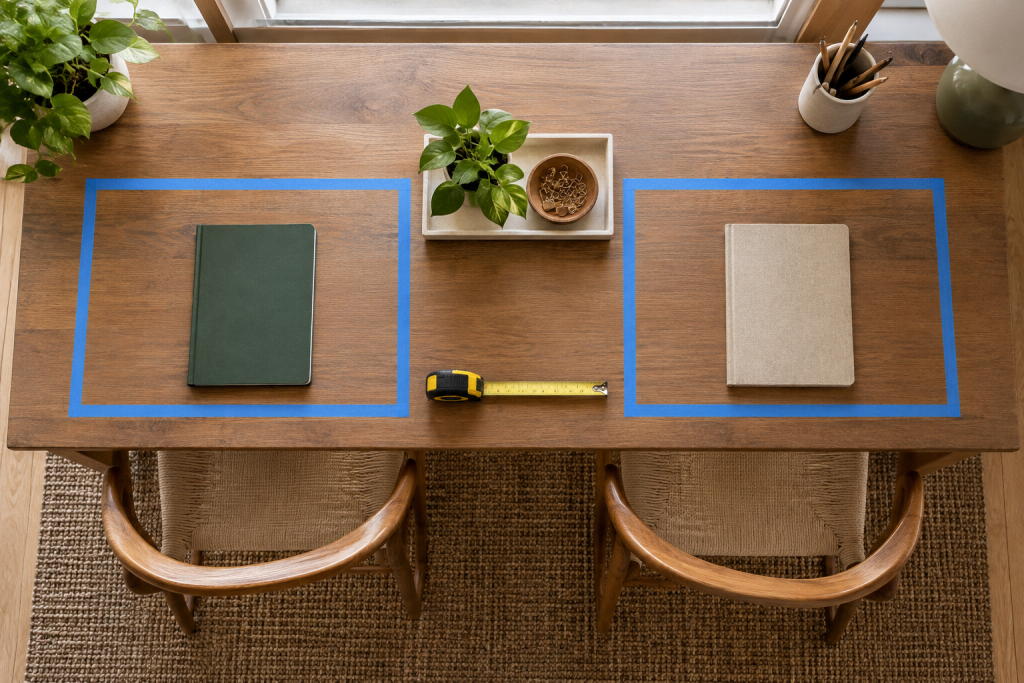
Measure the usable top after accounting for a monitor stand, lamp, or fixed shelf. Then measure the depth available in front of each chair. A desk that looks long enough may still be too shallow for two open tasks. Use paper or painter’s tape to outline each person’s actual work patch and sit in each chair for a few minutes.
Check whether the chairs can pull out, whether drawers can open, and whether someone walking through the room will brush the work. The same clearance-first measurement method used for closet organizers applies here: the route to an item matters as much as the item’s dimensions.
Do not treat sample dimensions in a blog post as furniture standards. Record the measurements of your own desk and chairs. If the surface is too small, prioritize a single clear task zone and schedule a handoff rather than buying bins to stack above unfinished work.
Give each person one home and create a neutral zone
Divide storage by ownership rather than by object type. Two people can each have a folder or small tray for current work. The shared area should hold only items both people use, such as a lamp or one pen cup. Avoid a “miscellaneous” pile in the center; it becomes a place where neither person knows who should move an item.
- Personal zone A: current task, one active folder, and frequently used tool.
- Personal zone B: the equivalent items for the other user.
- Neutral zone: shared items with an agreed return spot.
- Exit zone: paper or objects that need to leave the desk today.
The exit zone is not permanent storage. If papers enter faster than they leave, use a short processing slot. Our paper drop-zone guide gives a way to prevent a tray from turning into an archive.
Agree on a handoff rule
A shared desk is easier to use when the person finishing a session leaves it ready for the next task. Try a three-step handoff:
- Put active work into your own folder or tray. Do not move the other person’s papers without agreement.
- Return shared tools to the neutral zone and remove food or cups.
- Leave a short note only if an item must stay out: what it is, who needs it, and when it can move.
Use the same rule whether the handoff happens in the morning or evening. A five-minute reset is more reliable than expecting one person to make an occasional deep-clean. If both people work simultaneously, add a quiet signal for calls or focus time so the layout does not have to solve a scheduling problem.
Test a no-buy version for seven days
Use folders, trays, or boxes already in the home. Label them with removable notes, not permanent categories. For a week, record each time an item has no home or a work patch gets blocked. At the end, ask whether the problem is storage, surface area, scheduling, or an item that does not belong at the desk.
Only then consider buying something. A new tray should solve a named problem and fit a measured space; otherwise it is another object on the desk. The same logic underlies our realistic one-in, one-out approach, but shared tools should be decided together rather than removed by one person.
Copy this shared-desk card
- Person A’s main task and clear-space need: ______
- Person B’s main task and clear-space need: ______
- Usable desk width and depth: ______
- Personal zone A / personal zone B: ______ / ______
- Shared tools and their return spot: ______
- Exit-zone review time: ______
- Handoff rule: ______
- Problem to retest after seven days: ______
The card makes a vague complaint—“the desk is always messy”—specific enough to fix. If the two work patches still collide, the useful change may be a different schedule, not another organizer.
Quick questions
Should both people have identical storage?
No. Give each person enough space for their actual task. Identical boxes are visually tidy but can waste limited room when one person needs paper space and the other needs a tool drawer.
What if one person uses the desk much more?
Keep everyday items near that person’s work patch, but preserve a clear setup path for the other person’s scheduled use. Agree on the handoff rather than assuming the occasional user will work around everything.
What if the desk is also the dining table?
Use one portable folder or tray per person and a defined off-table home. The handoff then includes clearing the surface before meals. Avoid a storage solution that blocks the table’s primary use.
You Might Also Love

How to Measure a Closet Before Buying Organizers
Where to Store Towels and Sheets When You Have No Linen Closet
Under-Bed Storage: What Belongs There and What Does Not

How to Declutter a Closet Without Emptying Everything at Once

How to Keep Pipes From Freezing: 7 Checks Before a Cold Snap
via Yesil Rehber