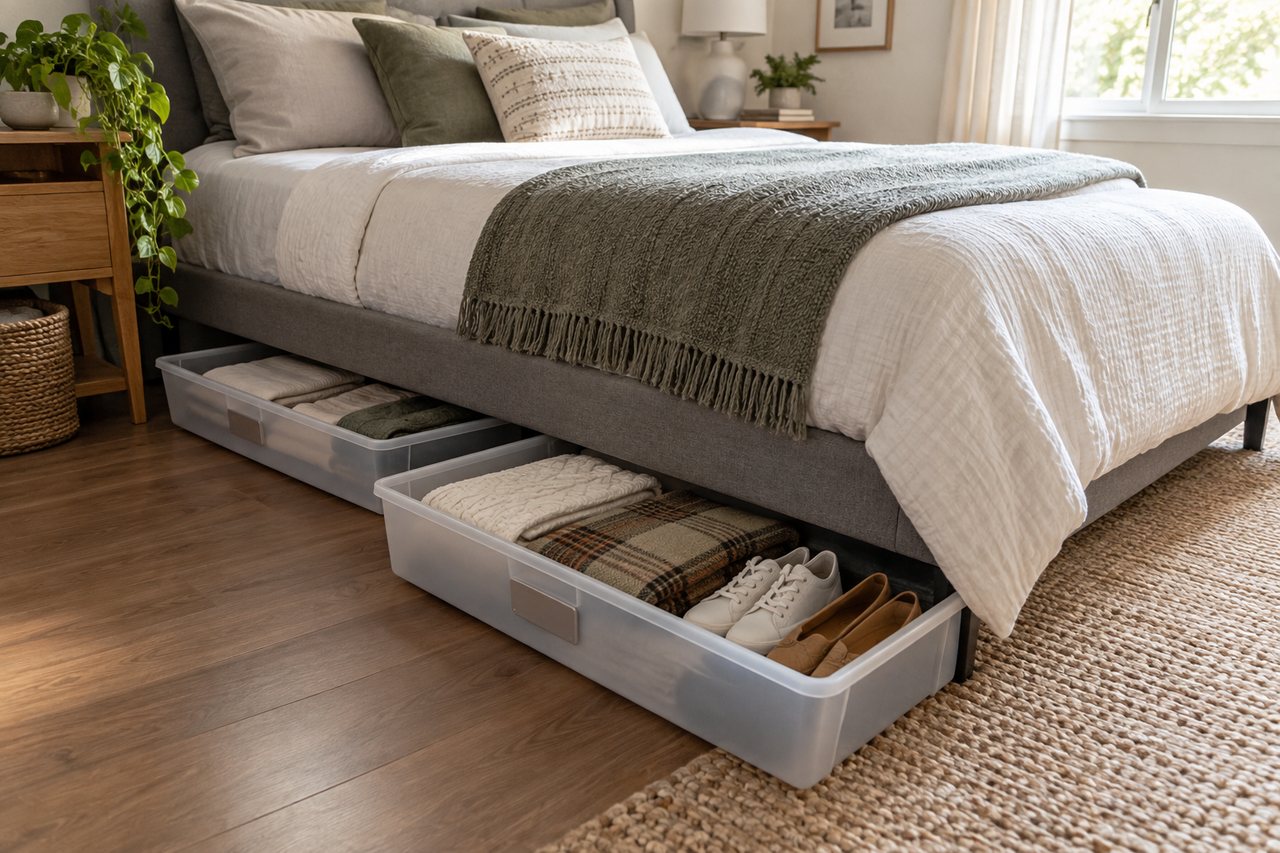
Under-bed space can be useful storage, but only when the items are easy to retrieve, protected from dust, and worth the inconvenience of bending down. Without those limits, it becomes a hidden holding area for things you have postponed deciding about.
The goal is not to fill every available inch. It is to give a small number of appropriate belongings a clear, maintainable home.
Measure before buying a container
Measure the clear height from the floor to the lowest part of the frame, plus the usable width and depth. Check for center supports, floor vents, adjustable-bed hardware, and rugs that reduce clearance. Leave enough room to grip and slide the bin; a container that technically fits but jams against the frame will not be used.
Painter’s tape on the floor can show the footprint before you buy. If you are comparing products, our guide to storage bins for small homes explains what makes a container earn its space.
The two-minute fit card
Write these measurements down before looking at product photos. Measure at more than one point; the smallest clear measurement controls the choice.
- Entry height: floor to the lowest edge the container must pass under: ___.
- Inner height: floor to the lowest support or hardware farther under the bed: ___.
- Clear width: space between legs, supports or other obstacles on the side you will use: ___.
- Usable depth: distance from that entry to the first obstruction: ___.
- Retrieval allowance: extra room needed to grip the handle, lift a lid or roll over the rug: ___.
Pass/fail check: the container’s outside height plus your retrieval allowance must be less than the smaller of the entry and inner heights. Its outside width and depth must also be less than the clear width and usable depth. Count wheels, handles and lids in those outside dimensions—not the box it ships in. A bin fails the test if it cannot travel all the way in and back out without lifting the bed or scraping hardware. Mark the footprint with painter’s tape or a cardboard rectangle first. Keep floor vents and adjustable-bed mechanisms clear; if the fit remains uncertain, choose a smaller container or use an existing drawer instead.
What belongs under the bed
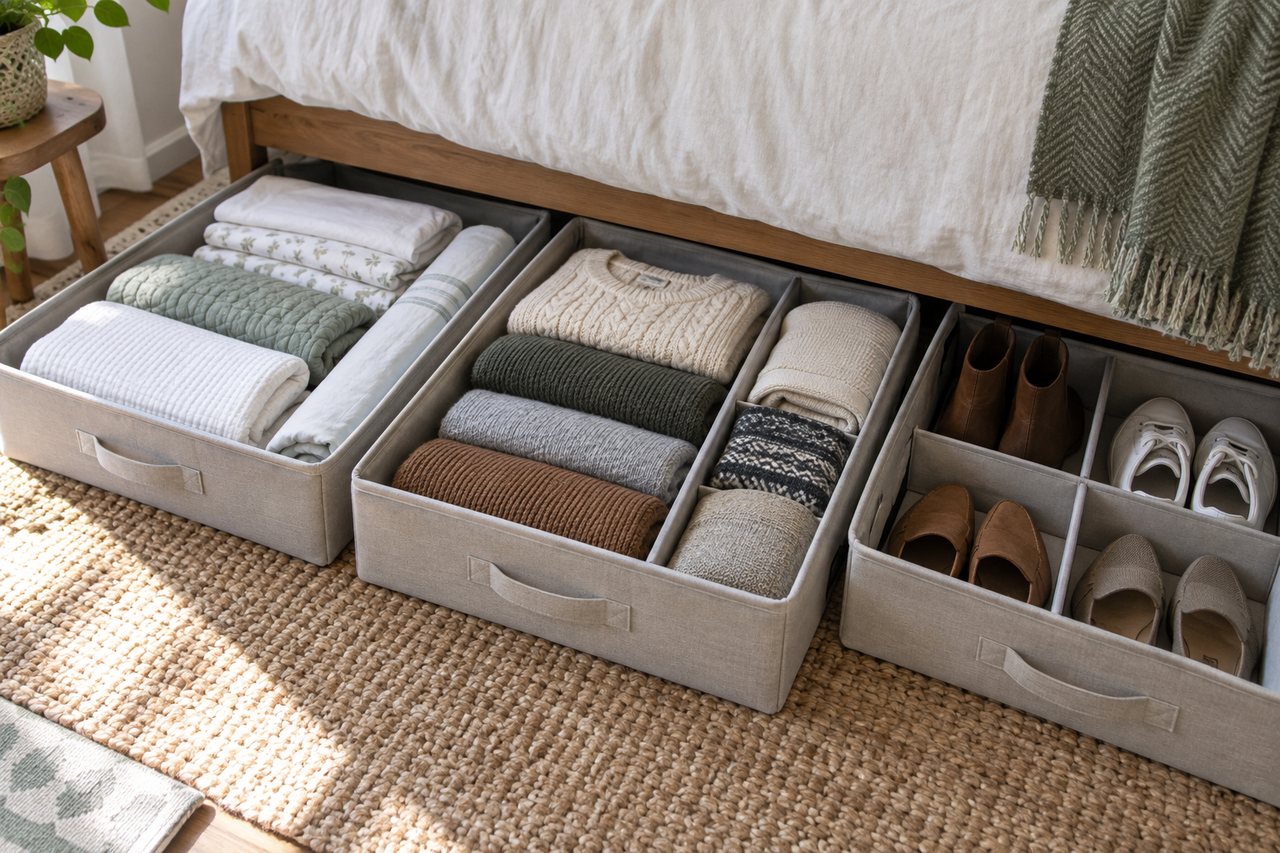
- Seasonal clothing: clean, fully dry pieces you will rotate on a known schedule.
- Extra bedding: one guest set or season-specific blankets in a protected container.
- Occasional shoes: clean pairs in divided or wipeable storage.
- Travel items: packing cubes, soft bags, or travel accessories used several times a year.
- Memory items: only a small, labeled group that tolerates the room’s conditions.
Good candidates are lightweight, non-perishable, and used occasionally but predictably. If you need an item every morning, a drawer or open shelf is usually better.
What should not go there
- Food, pet treats, or anything that can attract pests.
- Damp textiles, wet shoes, or items with an odor.
- Medicines, important documents, cash, or valuables needing secure or controlled storage.
- Candles, cosmetics, batteries, or electronics where temperature and dust may be a concern.
- Items you have not decided to keep.
- Heavy objects that are awkward or unsafe to pull from floor level.
Do not use storage to delay decluttering. The closet decluttering guide offers a contained way to make decisions first.
Choose closed storage in dusty rooms
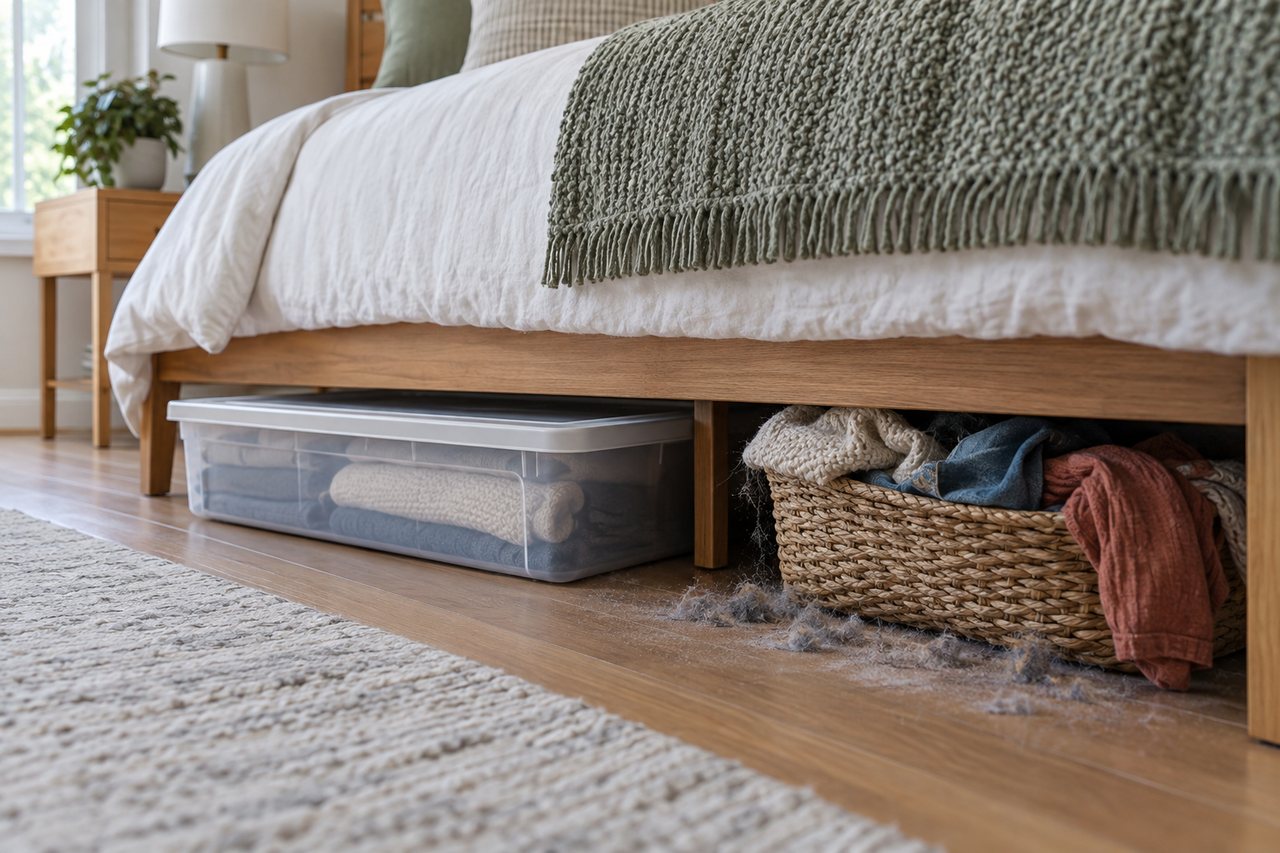
A lidded plastic bin gives firm protection and is easy to wipe. A zippered fabric bag is lighter and can compress slightly, but it should not be packed so tightly that the zipper strains. Open baskets suit only items used frequently in a low-dust space.
If anyone in the household is sensitive to dust, prioritize easy-clean floors, closed containers, and regular cleaning around the bed. Follow personal advice from a qualified health professional for allergy or asthma concerns.
Use one category per container
Label the short end that faces outward. “Winter accessories” is easier to retrieve than “miscellaneous.” Keep an inventory note on your phone only if the bins are opaque or numerous; otherwise a visible label is enough.
Apply the one-in, one-out method when a container reaches capacity. Do not solve an overfull bin by adding a second unlabeled bin.
Create a retrieval plan
| Use frequency | Best position | Review |
|---|---|---|
| Monthly | Near the open side | Each season |
| Seasonal | Farther under the bed | At rotation |
| Once a year | Only if clearly labeled | Annually |
| No expected use | Do not store | Decide now |
For a bed against a wall, use fewer long bins accessible from the open side. Wheels help on hard floors but may catch on rugs. Handles should be strong enough for the actual load.
A 15-minute setup
- Remove everything currently under the bed.
- Vacuum or wipe the floor and frame.
- Discard rubbish and relocate inappropriate items.
- Group the remaining items by category.
- Choose only categories that fit the space and access pattern.
- Pack, label, and record a review date.
Add the area to a periodic reset such as this realistic whole-home weekend reset. You should not need to unpack every container to clean around it.
Common mistakes
- Buying containers before measuring the frame.
- Using soft bags for sharp or very heavy objects.
- Storing unwashed clothing and creating odors.
- Blocking ventilation or adjustable mechanisms.
- Letting the space become an unreviewed donation queue.
Frequently asked questions
Are vacuum bags a good choice?
They can reduce volume for compatible textiles, but compression may crease fillings or fabrics. Follow the manufacturer’s care guidance and avoid storing damp items.
Should I use bed risers?
Only if the bed frame and risers are compatible, stable, and rated for the load. Do not improvise with blocks or unstable objects.
How often should I review the bins?
Review them at each seasonal rotation or at least once a year. If a labeled category has not been opened for several cycles, reconsider whether it deserves the space.
You Might Also Love

How to Organize a Shared Desk in a Small Home
How to Measure a Closet Before Buying Organizers
Where to Store Towels and Sheets When You Have No Linen Closet
How to Declutter a Closet Without Emptying Everything at Once

How to Keep Pipes From Freezing: 7 Checks Before a Cold Snap
via Yesil Rehber